Stop reading this. Go buy Clair Obscur: Expedition 33, and then come back and read this while the game is downloading and installing. It is also available via XBox GamePass, but I implore you to buy it instead, because games like this don’t come along often, and, when they do, I’d rather see the creators rewarded. I’d also like to see the publishers rewarded, as they were reportedly cool with postponing the game when necessary, and never forced crunch onto the developers. The game released complete, with no plans for DLC, no content removed for Day One DLC, and in a remarkably solid state with few, if any, bugs at all, much less major ones.
These alone are sufficient to buy the game in the modern industry, because the above paragraph is the exception rather than the norm. Crunch is common, games are frequently rushed, games are released in varying degrees of broken, and content is regularly cut from games in order to release it as DLC, and season passes are almost ubiquitous. Clair Obscur deftly avoided all of these problems, shining as a glorious example of how things should be, and was created by a team of passionate people.
And the passion shines through from the moment the game launches. From the wonderfully stylizes user interface to the varying music that accompanies the player throughout, it is immediately and continuously clear that love went into this game. The graphics are gorgeous, yet not simply realistic; there is also a style about them that is distinct, which is fitting for a game that is named after a painting style. Even the standard environments have twists and features to them that make them unique–you have never traveled through a city quite like Lumiere, and I don’t need to know your gaming history to be confident in that statement.
There is a huge variety in environments across the game, and they are all breathtaking. They also all lack a minimap, which many players have derided as causing tedious backtracking, but this is only true for players who haven’t yet learned the rules of the game or who were unwilling to adapt to them. Unlike Final Fantasy X, players can’t simply navigate a yellow triangle on a blue plane and must actually pay attention to the environment. This was a deliberate choice by the developers–in Final Fantasy X and similar games, developers expend tremendous resources making beautiful scenery, only for it to be completely ignored because navigation is confusing and obtuse, leading players to focus entirely on the minimap.
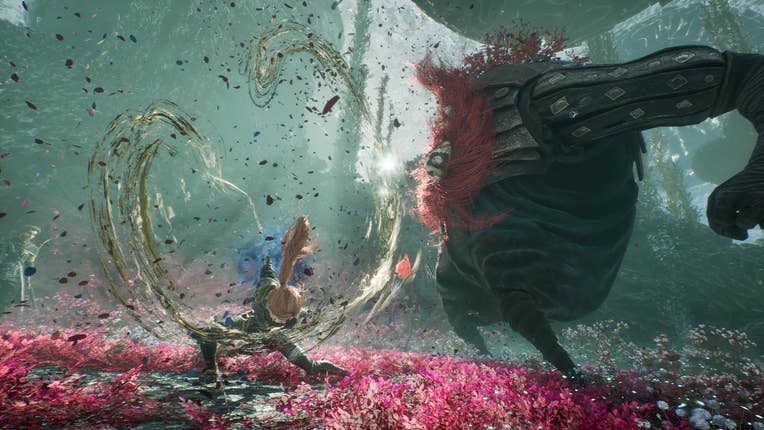
Image credit: Kepler Interactive
This may sound like it makes the game more difficult, and it does… for the first major area. After that, players should have learned the rules of the game, which is to pay attention to surroundings, because every area is diverse, with clear, unique landmarks that make navigation easy; it just requires looking for them, instead of counting on linear paths or a minimap (or in the case of Final Fantasy XIII both a minimap and a horribly linear path).
With a game designed to not have a minimap, it isn’t a problem to lack one, just like a game that is designed to not have a jump button does not create a problem by lacking one. The people complaining about not having a minimap to stare at while they ignore the exquisite and fascinating world that the developers made are simply people who do not want to adapt to the new situation. They want to run from A to B without paying much attention, because that is how modern games have acclimated them.
Here is the objective marker on your map. You have a minimap in the top-right corner of your screen. We’ll put a glowing dot where the objective is, though it may be on the edge of your minimap if it’s too far away. Don’t worry about missing any side content–we displayed the side paths clearly on the minimap, so they can’t be missed. Also, here, we’ll go ahead and add treasure chest icons to the minimap. Also, here’s a quest log, complete with a checklist, just so you can be absolutely sure you didn’t miss anything. And if that’s not good enough, here’s a completion percentage also.
The above is how most modern games present themselves to players. In Clair Obscur, it is not only easy to miss side paths, for players who aren’t watching close enough, but there are optional bosses, useful items, and other worthwhile stuff hidden on the side paths. After a few areas, players should get a feel for how the designers went about hiding things, because there is a great deal of consistency and thought, but even late into the game it’s easy to miss an alcove that leads to something, or climbing pegs subtly placed on a wall.
I tend to be pretty good at video games, and I would encourage everyone to play through the same way that I did: without using a guide. Many people have cited a 30-50 hour playtime, and by my reckoning that is based on people playing on Story Mode (drastically reduced difficulty) while using online guides. I was at about 100 hours when I started New Game Plus, and I had come pretty close to 100%ing the game, I think–there is no completion percentage. It’s okay to get lost and poke around for a while; that’s kinda what it means to play a game. If, however, you’re one of those people who requires a checklist and quest log and minimap, and you cannot adapt to playing a game as a game instead of as a spreadsheet that needs to be filled out, then you may not enjoy Clair Obscur as much.
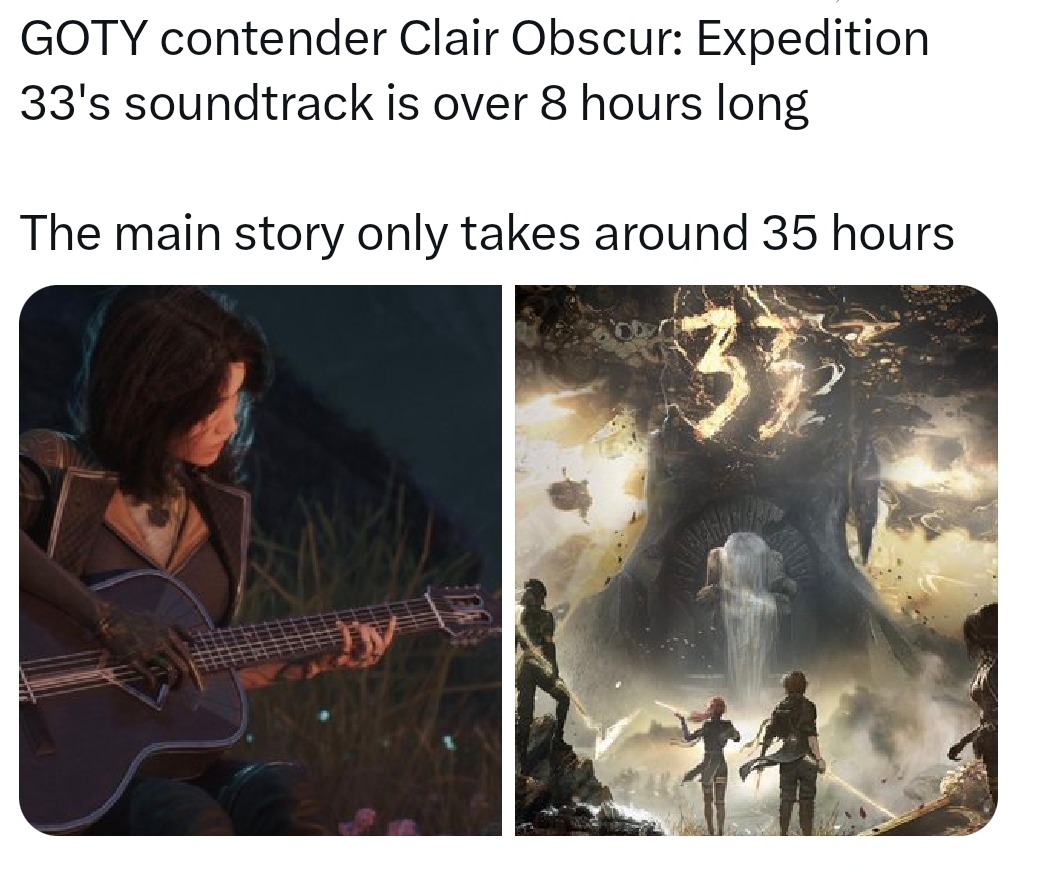
Visuals and an excellently designed world are not the only ways that Clair Obscur excels. The music is spectacular, and much of it features vocals, which is very unusual for a video game. However, now that I’ve heard it used so extensively during a game, I am left wondering why game developers continue to rely so heavily on instrumentals. Instrumental music was originally just a way to get around technical limitations in audio production–you couldn’t have singing with 8-bit bleeps and bloops. Even into the N64 era, singing wasn’t really possible, as including tracks with vocals on the N64 forced the Tony Hawk’s Pro Skater games to reduce the number, quality, and length of the tracks.
These limitations are no longer applicable. Games weigh in at 50 gigabytes and more, so a 3 MB mp3 file is trivial. Likely because of tradition, though, most music in video games continues to be instrumental, but this is decidedly not the case in Clair Obscur, which has some wonderful music. Through the entire game, only one track irritated me with its vocalizing, and that was in an optional area where someone spoke French through the song. It likely would have been less irritating if I could speak French, but I’ll confess to muting the music in that short, optional area.
Given how so much thought went into everything else, I have to think it was also deliberate to have such a great abundance of audio variety, as well. While all the tracks are great (except the one I found annoying), very few are repeated, and there are several different battle themes, which leaves very few of the songs actually being memorable, simply because they don’t play often enough to be. No matter how great a track is, if you only hear it once, it isn’t going to lodge itself in your mind. I suspect this was done to keep the music on par with the visuals and story, while ensuring that the visuals and story were the features that players remember most when they put the game down.
Obsession
Clair Obscur: Expedition 33 is the only game I have ever played that, if I was not playing it, I was actively thinking about it. This game had my attention in a way that no other game ever has, and I’m not alone in that assessment. There are many reasons for the obsession that possesses people when playing this whirlwind of a game, but the main reasons are the story and the characters. The game is so compelling that after the previous sentence, I stopped writing to go and play it, though I’ve already gotten 120+ hours in it.
I’m going to avoid spoilers as much as humanly possible, but no one ever feels truly safe throughout the story, and people die. This leads to some very surprising developments, where I asked a friend who was also playing, “They come back, right?” So few writers have the courage to do what Sandfall Interactive has done.
The obsession is real, and is owed to the intriguing characters, world, and story. Tremendous amounts of thought and effort went into the characters, all of whom have compelling motives and traits, with the possible exception of Lune, who is a fairly one-note character.
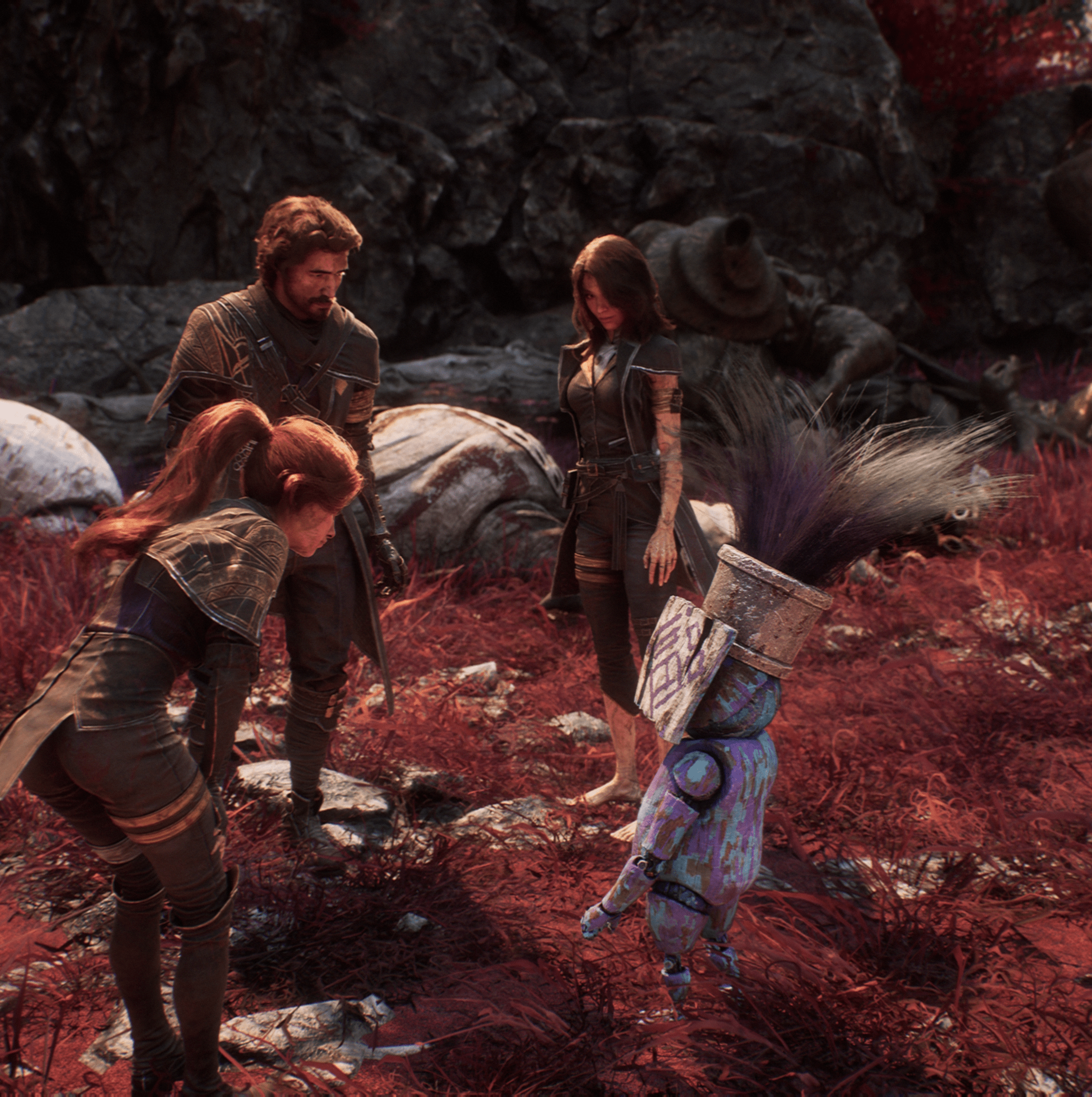
Esquie, while not actually a playable character, is a darling of the game, and I expected to find their mannerisms annoying based on what I read, but everything about Esquie proved endearing rather than irritating. Monoco at first was a character I didn’t think I’d like, but I discovered a great deal of depth within him, and was as captivated by him as any other. As a mage, Lune had the easiest path to my heart, and it really speaks to the strengths of other characters that by the middle of the second act I was tired of her and more intrigued by Sciel, whose tragic background puts her carefree and good-spirited character in a very different light. There is also Verso, who has the odds stacked heavily against him in terms of likability, but even he managed to win me over. Finally, there is Maelle, clearly preferred charger of the game and obviously the true main character, whose conflicts immediately propel the narrative forward.
There is so much more going on in this world than it initially seems, which is impressive, given that it is bustling with vibrance and intrigue from the start. The main enemy of the game is the Paintress–like a sorceress, except she paints. Not only does this make perfect sense in the context of the game world, but it also adds layers of interest to the creative masterpiece that is Clair Obscur: Expedition 33. Players are never bored, and it’s rare to actually feel like you have a solid handle on what is going on.
That said, Clair Obscur does not take its cue from the half-assed endings of American horror movies. Events actually get explained in a satisfactory way, although a few pieces of the story are merely alluded to, and the endings (of which there are two) leave players feeling a little uncertain about it all, especially concerning whether they made the right decisions. It is near the end of the game that the threads begin to unravel in a way that allows players to see the full canvas, and the revelations never feel unwelcome or completely unexpected.
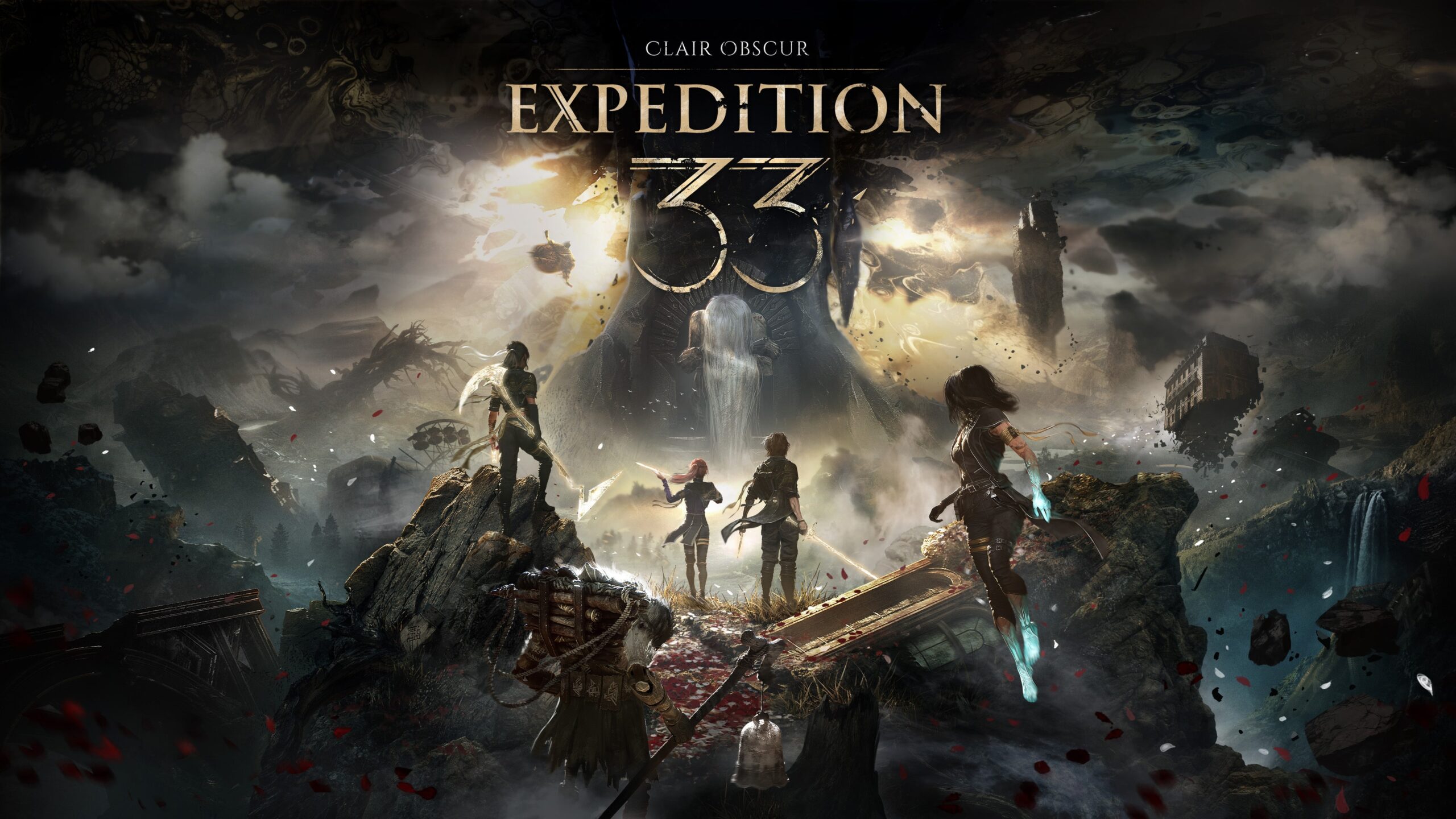
Given that I’ve focused heavily on the story, you might assume that the gameplay is the lesser part of the package, but that would be incorrect. Clair Obscur: Expedition 33 borrows heavily from Final Fantasy X, and one clear inspiration is the combat. Like FFX, a turn order appears (although in the top-left of the screen instead of the right) giving players a clear understanding of what is upcoming in the turn-based fight. There is no half-assed, awannabe Devil May Cry here–it is truly turn-based, and the best take I’ve seen of the style since Bravely Default.
There are dreaded Quick Time Events, but they are not obtrusive or particularly destructive if players miss them. Nearly every attack features one or two, and nailing the timing increases the damage the character does by roughly 5%. Thankfully, it is always the same button needing to be pressed, and no attack has an obnoxious “Press A, then X, then Y, then X twice” QTE. Instead of feeling forced and grating, the QTEs are a minor but welcome addition to the combat.
More importantly, players have the option to dodge incoming attacks, parry incoming attacks, and, occasionally, jump over incoming attacks. This is where the combat shines brightest. Windows to dodge attacks are more forgiving, and there’s no need to worry about whether to Dodge or Parry–both work for nearly any attack, with the only exceptions being enemy Gradient Attacks (which require a different button, but which are also obvious when the enemy uses one, as the game goes grayscale) and attacks that must be jumped over. Attacks that must be jumped start with a clear icon in the enemy animation, and attempting to dodge or parry will result in a hit to the characters. Jumping is easy, and by far the easiest way to counter attacks, as the counter window is fairly forgiving.
Dodging is easy, but parrying is how you win, because it comes with a free counterattack that hits much harder than a standard base attack. It is entirely possible to go through the game without ever taking damage, by mastering the parry mechanic. Audio and visual cues on parry timing are usually clear, but don’t interpret this to mean the timing is easy to master. A no damage run is definitely possible, but it will take a lot of practice, and don’t expect it to happen on your first (or first ten) playthroughs, even in Story Mode (what the game calls Easy difficulty).
Recent patches have made Story Mode easier, though I would recommend going through the game in its intended normal mode. The difficulty is masterful, and the difficulty curve is expertly handled. Enemies begin the game having a single, choreographed attack, but as the game progresses players will find themselves needing to parry, party, jump, and then parry again. It is also refreshing to reach a new area and encounter entirely new enemies, only to barely survive.
Difficulty in games can vary wildly, and can mean drastically different things. Difficulty in the original Resident Evil 2 meant carefully managing one’s resources across an entire playthrough, including the ability to save, and some games, especially RPGs, start out challenging and only get easier. Clair Obscur: Expedition 33 manages to be the rare JRPG that begins relatively easy, and actually gets more difficult. Enemies pick up more attacks per turn and their attacks become harder to parry.
It is the norm here to reach a new area and barely survive the first several battles while the player learns the new enemies and their attack patterns. On normal difficulty, it’s usually not enough to cause a game over, but, even if it does, a game over is a trivial setback, as the game will restart you just before the fight. Bosses, on the other hand, will cause party wipes, as they should.
Players shouldn’t easily defeat every boss they encounter. You’re supposed to die a few times while you learn the attacks and how to counter them. It always feels fair, and players will notice themselves improving against the new enemies and bosses, taking fewer hits and surviving longer. Many people seem to think that they should down every boss on the first encounter, and maybe that’s the case in a lot of games, but it won’t be the case here, and the experience is better for it.
The difficulty here is reminiscent of the NES Mega Man games. It is typical, in those games, to experience one or two game overs while trying to reach the boss of the stage. Players will likely reach the boss in a Mega Man game with one life left, and will lose. Their next attempt will usually have them reaching the boss with two lives, and they’ll start to learn the attacks. On the next attempt, the player will often beat the boss. Players constantly get better at dealing with the enemies and challenges, learning the boss’s patterns and how to deal with it, and ultimately overcome it. This is the exact same arc of new areas and bosses in Clair Obscur: Expedition 33. It never feels unfair or punishing.
Accessibility
In addition to including Story Mode for those who wanted a less challenging experience, which came at the request of one of the voice actors, Clair Obscur: Expedition 33 shows unusual and remarkable care for its gaming audience, as the accessibility features go above and beyond the normal “colorblind mode” and “text to speech” like are typically found in accessibility settings. There is an option to reduce some of the wild camera behavior during battles, an option to automatically perform the QTEs, and more. Could Sandfall Interactive have done even more to make the game accessible? Yes, probably. I don’t know, as I’m grateful to be among those who don’t typically need to use accessibility features (other than subtitles). But they did more than I’m accustomed to seeing, and they deserve credit for that.
I’ve got 120 real hours in Clair Obscur: Expedition 33, and I still play it about once a week. It earned all that time, and I didn’t accidentally leave the game running for a day or two. This is a game that you can really sink yourself into, and one that you will want to get lost in. It’s the sort of game that only comes around every so often, and I don’t recall the last time that I was so enamored with a game and drawn into its world. I firmly believe everyone should play this game, and I don’t think anyone would regret the experience.