I’m creating a series of videos on my Under the Hood Gaming channel that is focused on the psychological exploitation and manipulation prevalent in modern game design, including single-player games where you ordinarily wouldn’t expect that sort of thing. The series was debuted earlier with a feature on the Quest System.
I’ve talked about the Quest System before, and I mentioned Dragon Age: Inquisition a lot, and it still breaks my heart that Inquisition was what it was, instead of being a masterful story experience about the war between the Chantry and the Mages (a war that took a backseat in Inquisition before being effectively resolved in a single quest). While I will have to truly get my heartbreak expressed one day, that isn’t today, and instead this video is about the Quest System.
There’s a moment in every gamer’s life when they realize they’re not having fun anymore—they’re working. Maybe it’s the fiftieth “collect 10 of X” quest in Dragon Age: Inquisition. Maybe it’s staring at a minimap instead of the beautiful world developers spent years creating. Maybe it’s that sinking feeling when you see a 99% completion rate and know you’ll lose sleep until you find that last collectible.
If you’ve experienced this, congratulations: you’ve discovered how modern game design has transformed players from adventurers into unpaid digital laborers.
The Birth of Digital Serfdom
The quest system epidemic didn’t start with malicious intent. Like many gaming disasters, it began as a practical solution to a technical problem. In 1999, EverQuest faced a challenge no one had solved before: how do you provide content for thousands of concurrent players without destroying your servers or requiring an army of writers?
The answer was the now-infamous [Action] [Number] [Object] template. Kill 10 wolves. Collect 15 herbs. Deliver 3 packages. These weren’t designed to be engaging; they were industrial efficiency made interactive. Fast food for the brain, served by algorithms instead of chefs.
World of Warcraft perfected this system after discovering that testing players constantly asked “what’s next?” The solution proved to be quest chains that constantly guided the player, and predictable rewards, essentially turning the game into a sophisticated task management system, complete with Pavlovian conditioning. It worked brilliantly—for MMORPGs dealing with massive populations and technical constraints.
The problem came when single-player games started copying these systems without understanding why they existed in the first place.
The Great Contamination
Between 2010 and 2015, something catastrophic happened: developers began importing MMO mechanics wholesale into single-player experiences. Games that should have been carefully crafted adventures became checklist simulators, trading meaningful exploration for content volume metrics.
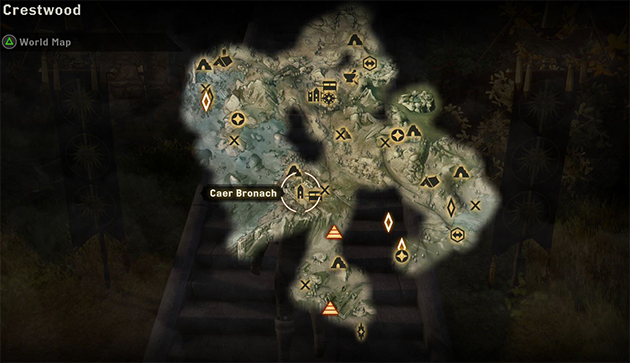
Dragon Age: Inquisition became the poster child for this contamination. BioWare, reacting to criticism about Dragon Age II‘s reused environments, decided bigger was better. Instead of handcrafting content, they imported MMO design: vast zones with sparse content, fetch quests requiring multiple collectibles, and a “Power” currency that forced players to complete side quests to progress the main story–and to wait many real-life hours, exactly like the garrison missions of World of Warcraft.
The result was what players immediately recognized as a “single-player MMO”—a game that felt designed for multiple players but trapped you in solitary digital labor. Maps became to-do lists filled with quest hubs and littered with quest objectives. Exploration became all about optimizing efficiency.
Adventure became work.
Even Nintendo, once the masters of tight game design, fell into this trap. While Breath of the Wild mostly got exploration right, they looked at their success and thought players wanted more collecting. Enter Tears of the Kingdom with its device hoarding mechanics—because apparently Link’s greatest adventure is becoming a digital packrat.
The Psychology of Exploitation
The most insidious aspect isn’t boring gameplay—it’s how these systems exploit fundamental psychological mechanisms. Modern quest design leverages principles that make gambling addictive and workplace surveillance effective. To be fair, the gameplay usually is boring: since it relies on exploiting innate psychological traits to drive engagement, they don’t have to be entertaining. Being fun becomes superfluous, because players will do it whether it’s fun or not, simply because they need to check the item off the lost.
The Zeigarnik Effect explains why unfinished tasks stick in memory more than completed ones–your brain literally can’t let go of unchecked boxes. Game developers exploit this by creating infinite task lists—every objective cleared spawns more map markers, every quest completed unlocks three more. It’s psychological quicksand.
Completion Anxiety triggers when you see percentage meters. That 97% completion rate? Your brain interprets that missing 3% as a personal failure, creating genuine stress that won’t resolve until you find every collectible. It’s weaponized perfectionism.
Cognitive Offloading occurs when external systems replace internal thinking. When games provide minimaps and quest markers, your brain stops creating mental maps. You become dependent on UI to navigate, like using GPS so much you can’t find your way home without it.
Compare this to Clair Obscur: Expedition 33, which deliberately has no minimap. Players must “actually pay attention to the environment” because developers trusted them to navigate like human beings. The result? After 120+ hours, I’m still discovering details in areas I’ve visited dozens of times. When games don’t spoon-feed objectives, you engage with the world instead of clearing it like a to-do list.
The Minimap Menace
Perhaps no mechanic better illustrates these problems than quest markers and minimaps. These systems fundamentally alter how players interact with game worlds, reducing rich environments to waypoint connections with everything between treated as obstacles to efficiency.
Try playing any modern Zelda game without the map constantly open—you’ll realize Hyrule is basically identical hills with copy-pasted trees. Compare this to Morrowind, which provided detailed directions: “Go along this road, till you pass the big oak, we call it ‘Widow’s Oak’… Right past it, go right, go along the small pathway until you see some rocks.”
Modern games simply update your UI and call it navigation. It’s like having conversations through PowerPoint presentations.
The Standardization of Wonder
The real tragedy isn’t just individual boring games—it’s that entire genres converging on identical templates. The “Ubisoft Tower” became synonymous with lazy open-world design: climb structure, reveal map icons, clear markers mechanically. Even when Assassin’s Creed creator Patrice Desilets apologized for unleashing towers on gaming, it was too late—the template had metastasized.
Nintendo looked at Ubisoft’s formula and decided it needed more grinding, scattering shrines across Hyrule like someone sneezed collectibles onto the map. At least Ubisoft’s towers were visible from a distance. Nintendo made you hunt for content like digital Easter eggs containing disappointingly similar puzzle boxes.
This standardization eliminates genuine surprise. When you know that noteworthy encounters only appear at points of interest, exploration becomes predictable pattern recognition rather than authentic discovery. Players develop metacognitive expectations that shape how they approach all games, training them to think of virtual worlds as productivity software rather than spaces for imagination.
I recently bought the RoboCop game because it was on sale for $5, and I quit less than ten minutes in, because this was a first-person shooter, and it had just given me a Quest that I could view by pressing L, which was broken down into other objectives that would populate as I completed them, and the game helpfully provided a Skyrim-like compass at the top of the screen pointing me exactly to where I needed to go. Don’t explore, don’t look around, don’t play a game–just follow this series of breadcrumbs to where the developers want you to go. No thought needed!
When our first-person shooter plays and acts like Skyrim, it foretells a major problem in gaming: this homogenization means every game is increasingly like every other game. RoboCop might as well be Skyrim, but the dealers are putting out Nuke instead of Skooma.
The Resistance
The encouraging news is some developers have recognized these problems and pioneered alternatives. Breath of the Wild revolutionized open-world design by using towers to reveal terrain without populating maps with objective markers. Players must manually scout points of interest, fundamentally changing how exploration feels. Clair Obscur: Expedition 33 bucks all of these homogenous trends to create an experience that is engaging because the gameplay and story are compelling, rather than because of innate psychological weaknesses.
Alternatives prove engagement doesn’t require exploitation. Games can trust players to explore organically when designed for intrinsic rather than extrinsic motivation.
Reclaiming Our Agency
The quest system epidemic represents a broader crisis in interactive entertainment. When games prioritize retention metrics over player satisfaction, completion rates over genuine engagement, and behavioral manipulation over creative expression, we lose something essential about what makes play meaningful.
We’ve turned the medium that should celebrate human agency into sophisticated mechanical operations, transforming players into digital pieceworkers measured by productivity metrics and completion percentages rather than experiential richness.
But recognition is the first step toward recovery. The success of games like Clair Obscur: Expedition 33, Outer Wilds, and Elden Ring suggests audiences hunger for authentic exploration rather than sophisticated task management.
The next time you boot up a game and see a map covered in objective markers, ask yourself: Am I playing, or am I working? Am I exploring a world or clearing a checklist? Am I having an adventure or performing digital labor?
The answer might surprise you—and change how you think about the games you choose to play.
Gaming can be more than sophisticated behavioral manipulation. It can be a space for genuine discovery, meaningful choice, and authentic play. But only if we recognize the difference between games that respect our humanity and games that treat us like expensive lab equipment designed to generate engagement metrics.
The choice is ours. We just have to remember that we’re players, not products.
For more analysis of how the gaming industry exploits player psychology, watch the full “Getting Played: The Quest System Trap” video and subscribe to Under the Hood Gaming.*